I went to the Kunming Art Biennale. I didn't think it was very well put together.
The exhibition's theme is “On the Road,” with subthemes such as “The Road of Life,” “The Road of Art,” and “The Road of Time.” The theme is so broad that almost anything could fit, which makes it all the more necessary for the curators to make choices and draw out relationships between the works. But the works on display were all over the place, in both subject and quality. The curators had simply divided them by medium—painting, sculpture, photography—with no coherent route through the exhibition and little explanation of the works. I saw plenty of works that could fit under “the road,” but I couldn't see why they had been put together.
I saw a photograph of Kunming South Railway Station, the high-speed rail station. It was no better than an ordinary tourist snapshot, yet there it was, on display without a hint of embarrassment. It certainly fit the theme of “the road.” If the curators had placed it at the intersection of the road of time and the road of life, in a meaningful sequence—historical photographs of Kunming's old railway station, migrant workers' luggage, the builders of the Chengdu–Kunming Railway, Kunming South Station, a high-speed train carriage, young people leaving Kunming today—then even a photograph with such an ordinary visual language might have gained some historical weight through its connections with the other works. But the curators hadn't done that. It just hung there, ordinary and alone.
How should we curate an exhibition, and how should we look at one? Beyond the artistic qualities of the individual works, an exhibition should also build a meaning of its own, with curators and visitors meeting each other in the search for it. Curating is a way of reshaping meaning with limited resources. It doesn't necessarily take much money or institutional backing. It doesn't matter if you can't borrow Along the River During the Qingming Festival or the Mona Lisa. You can work with whatever is around you.
There is a café on the third floor of the art museum, with an open gallery on either side. The galleries held works about ethnic cultures, history, and Yunnan, while the café was playing Louis Armstrong's “What a Wonderful World.” So I went through the exhibition accompanied by Louis's gravelly voice. Just like that, the café's music had become the exhibition's soundtrack. Once sound has entered an exhibition, the curators ought to take it into account. Even if the café is independently run, they could discuss the background music beforehand and choose songs that speak to the works, letting the café contribute to the atmosphere of the exhibition. That wouldn't cost much either.
Two paintings left a stronger impression on me.
One was enormous, showing women from Yunnan's various ethnic minorities in different poses among banana trees. I found this painting strange. The women came from different ethnic groups, wore different clothes, and had different faces, but their breasts were almost exactly alike: full, round, and firm. It was as if their differences disappeared at the breasts, leaving only a single template for the body. My own eyes were drawn to that uniform fullness and roundness, and I found myself caught in that gaze too. I don't know whether the artist intended this or whether it had slipped out unwittingly.
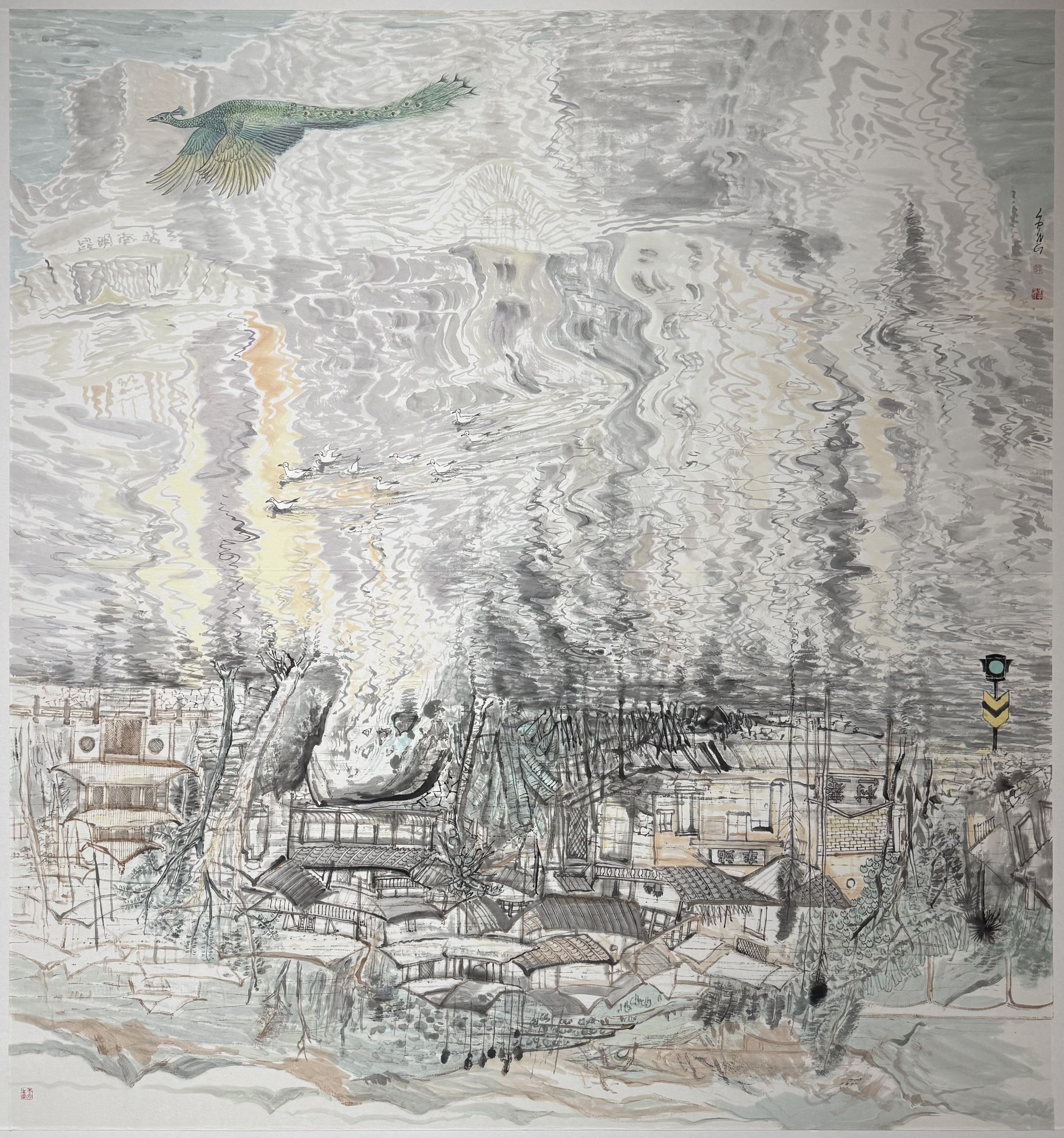
The other work was an upside-down painting. The lower half showed a corner of a town turned on its head. In the grey and white scene, a bright traffic light marked the town as modern. The upper half showed the town reflected in water. The reflection was upright, the real town upside down. Both were painted with ink-wash or watercolour techniques, hazy and diffuse. But higher up in the reflection, there was also a peacock in flight, its wings spread, painted with the meticulous detail of something close to gongbi: distinct feathers, a complete outline. Everything around it had been broken up by the ripples. Only the bird remained clear, as if the water had no effect on it. Was it a reflection too, or was it flying above the water? There was something of Zhuangzi about the whole painting. The modern town, which ought to have been solid and real, seemed to exist in a dream, a bubble, a passing shadow. The mythical bird in flight, which ought to have been an illusion, was perfectly clear. Where was the dream, and where was reality?